01
Machine learning
How a model learns relationships from examples. Separate training data from test data before measuring performance.
Train a baseline
Stuyvesant High School · New York City
A student-led AI club where research becomes publications, ideas become working projects, and learning reaches beyond the classroom.
Learning alongside
our collaborators




Read. Research. Publish.
Research and publications are at the center of SurfAI. We turn curiosity into questions we can test, explain, and share.
Our journal makes complex developments in AI, finance, and science easier to investigate and discuss.
We bring hands-on research and publication experience, including first place in TerraFair’s Software / Robotics category.
We connect technical curiosity with community needs, especially healthcare and medicine.
A foundation for every curious mind
Nine starting points. Real concepts, useful examples, and a next step for each.
How a model learns relationships from examples. Separate training data from test data before measuring performance.
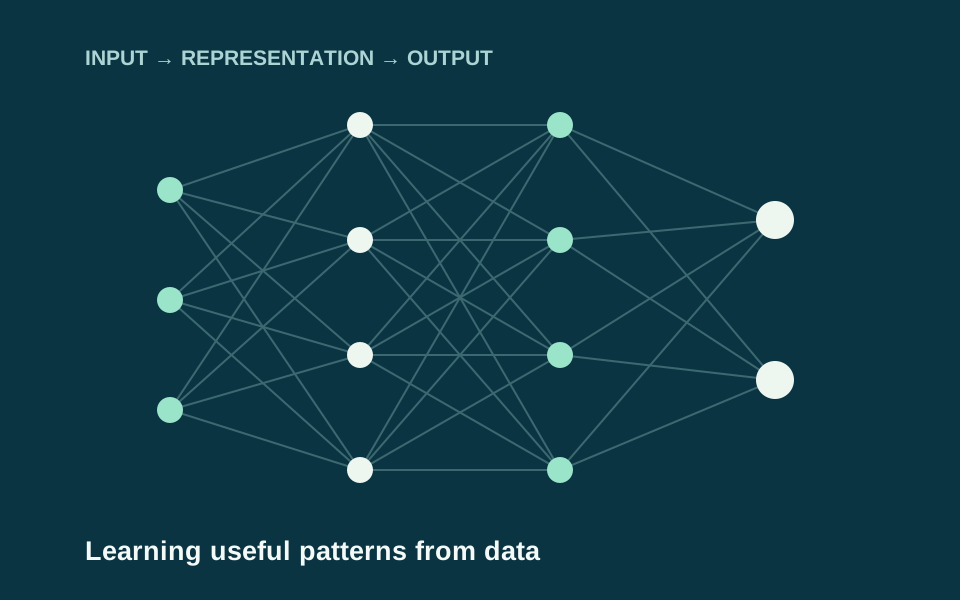
Train a baselineLayers transform inputs into useful representations. See how weights and a loss function guide learning.
Explore the layersTokens and attention help models relate one part of a sequence to another. Context is useful; it is not a guarantee of truth.
Try attentionLearn how models locate, classify, and track patterns in images. Lighting and camera angle can change a prediction.
Open the camera labDiffusion and autoregressive models generate new samples. Compare a plausible output with evidence from the real world.
Understand generationAn agent learns from rewards. A high reward can still miss the goal if the reward is poorly specified.
Study reasoningRetrieval adds relevant sources; agents can use tools. Build in checkpoints, permissions, and ways to recover from failure.
Trace a workflowTest beyond a single accuracy score. Study precision, recall, bias, privacy, and the cost of a wrong answer.
Run an experimentExplore medical imaging and biological models. Ask what was validated, on which population, and under what conditions.
Read the researchThe SurfAI Journal
Seven issues explore AI’s changing relationship with research, technology, finance, and society. Meet the ideas, follow the sources, and bring your own perspective.
Learn by doing
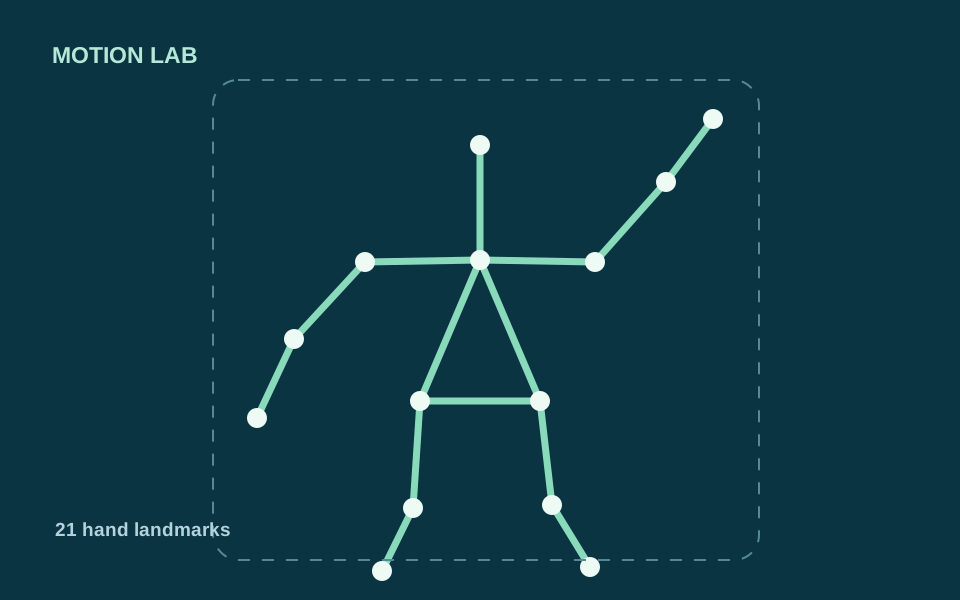
Try live gesture recognition, explore heat and health, examine pet-food labels, or experiment with image resolution. Each lab shows its method and limitations.