Machine learning
Learn from examples. Test on new ones.
Supervised learning maps examples to labels or numeric targets. Unsupervised learning looks for structure without those labels. In either case, decide what success means before choosing an algorithm.
For a first project, compare a majority-class baseline with logistic regression or a small tree. Split by person or source when related samples could leak information across the training and test sets.
Neural networks
Build representations, layer by layer.
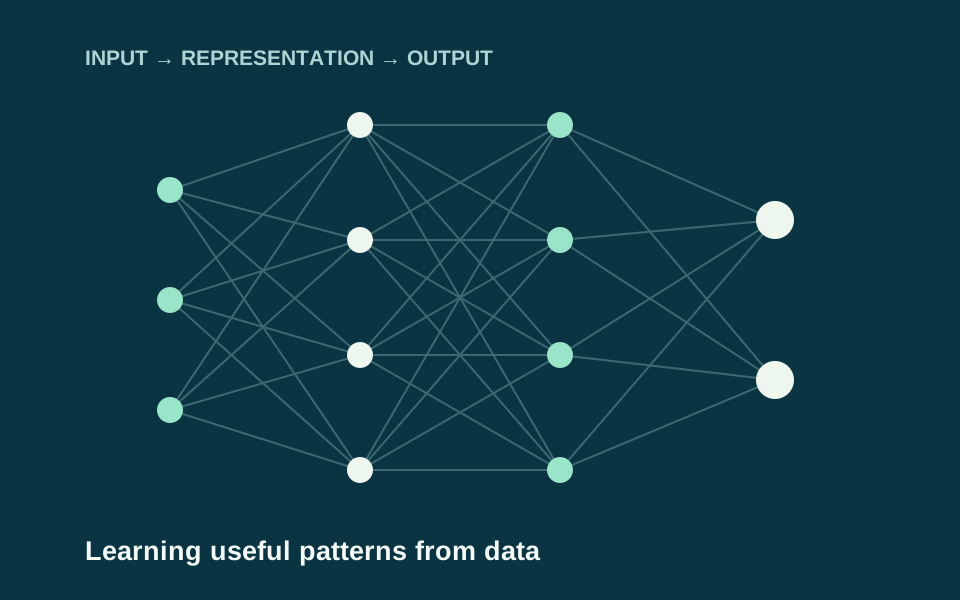
A neural network repeatedly transforms its input using learned weights and nonlinear functions. Training changes those weights to reduce a loss. More parameters alone do not guarantee a more useful model.
Train a compact network on a small public dataset. Plot training and validation loss, and look for the point where learning the training data stops helping on held-out examples.
Language & transformers
Attention connects the context.
Transformers use attention to combine information from different positions in a sequence. Tokens are model-specific pieces of text, not always whole words. Attention weights describe a computation; they are not a complete explanation of a model’s reasoning.
Choose a token below to change this illustrative attention distribution. The values are authored teaching examples, not weights taken from a trained language model.
Interactive concept
Which words connect?
Select a word to explore an illustrative attention pattern. Values sum to 100%.
Computer vision
Turn pixels into measurable patterns.
Image classification assigns a label. Detection locates an object. Segmentation marks regions. Tracking connects observations across frames. These tasks can support very different products even when they use similar inputs.
Try the gesture lab under different lighting and camera angles. Record failures as well as successes, and distinguish frame rate from inference speed.
Generative models
Generate a possibility, then evaluate it.
Autoregressive models predict the next element of a sequence. Diffusion models learn to recover a signal from noise. Both generate outputs from learned patterns rather than checking every result against the world.
Use a fixed prompt set to assess relevance, consistency, and factual accuracy separately. For scientific outputs, ask how the result could be tested outside the model.
Reinforcement learning
Learn from rewards, with the right objective.
Reinforcement learning improves a policy through feedback about actions. The DeepSeek-R1 work published in 2025 demonstrates one influential application to language-model reasoning. Reward design and evaluation still determine what a success claim means.
Write down a reward for solving a maze. Then invent a way an agent might maximize that reward without reaching the goal. Fix the reward and test again.
Retrieval & agents
Give a system context, tools, and boundaries.
Retrieval-augmented generation fetches relevant material before an answer is produced. An agent can choose tools and act over multiple steps. Source retrieval, tool execution, and answer quality each need their own evaluation.
Build a small FAQ from public club documents. Check retrieval against questions with known answers. Require review before the system sends a message or changes external data.
Evaluation & responsible AI
Measure the error that matters.
Accuracy, precision, recall, calibration, and latency answer different questions. In healthcare, missing a real case and raising a false alarm can have very different consequences. Choose metrics that match the decision and population.
Use the simulation below to see how prevalence changes the meaning of a positive prediction. Hold the sensitivity and specificity constant so only one assumption changes.
Accuracy, precision, and recall
Interactive model · illustrative data
Why accuracy can mislead.
Imagine screening 1,000 samples. This example uses a fixed 90% sensitivity and 95% specificity. Change how common the condition is and compare the results.
Only 9 of 59 positive predictions are true positives in this rounded example. A high accuracy score can hide many false alarms.
Teaching simulation, not a clinical model or a claim about SurfAI’s products. Counts rounded to whole samples.
AI for health & science
Connect a prediction to a scientific question.
Medical imaging, molecular structure, and genomics require different evidence. Recent examples include AlphaFold 3, AlphaGenome, and MedGemma 1.5. A promising benchmark result is a starting point for evaluation in the intended setting.
Read one source and make a five-column table: task, data, baseline, metric, and limitation. Identify whether the result is retrospective, prospective, or experimentally validated.